Passing on the Faith with a Baptismal Gown
My grandmother, Henrietta, was a remarkable mother figure whose quiet strength, wisdom, and love shaped everyone around her. Born in Poland and educated through the fifth grade at Porter Elementary School in Syracuse, New York, she was largely self-taught yet possessed extraordinary skill in domestic life. She sewed, crocheted, embroidered, baked, and cooked with meticulous care, all while preserving the Polish Catholic traditions that formed the foundation of our family life.
Henrietta placed God firmly at the center of her home. Her life was shaped by prayer, sustained by the sacraments, and illuminated by the steady light of Christ. Faith was not something she spoke about often, but something she lived. Through her example, she passed on not only practical skills, but a profound legacy of love, devotion, and trust in God’s providence.
Her faith found concrete expression in her service to the Church. Henrietta served as president of the Polish Ladies’ Charity Circle of Sacred Heart Church, now the Basilica of the Sacred Heart of Jesus, in Syracuse, New York. In this role, she devoted herself to the corporal works of mercy, providing food, clothing, and emergency assistance to needy parishioners.
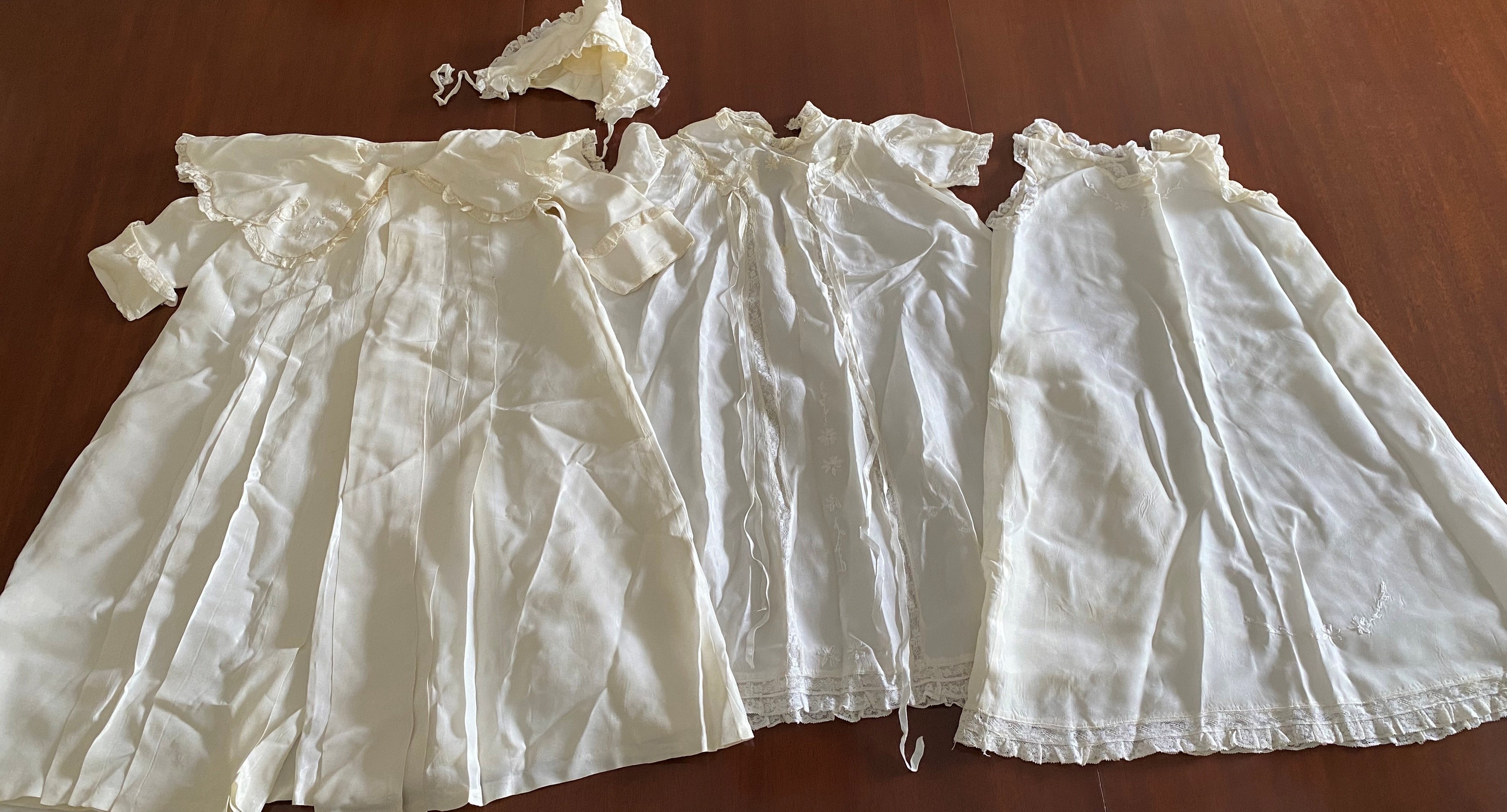
When Henrietta learned that her first grandchild was on the way, her faith once again guided her hands. With reverence and love, she created a baptismal gown of white satin and lace, intended not merely as clothing, but as a sacred family heirloom. As a devout Catholic, she firmly believed that a child should be baptized as soon as possible after birth, so that the grace of the sacrament might be received without delay. Her conviction echoed the words of Christ: “Let the little children come to me” for to such belongs the kingdom of heaven” (Matthew 19:14).
In past generations, it was common for mothers and grandmothers to sew baptismal gowns by hand, especially within Catholic families. These garments were not merely practical, but deeply symbolic and created with care, prayer, and the hope that they would be passed down through generations. Baptismal gowns were designed to be worn by many children over time, becoming cherished heirlooms that connected family members not only to one another, but also to the Church’s sacramental life.
Within Polish Catholic culture, such practices carried particular meaning. Faith was lived within the home as well as the parish, and domestic traditions reinforced sacramental life. For Polish Catholic families, these heirlooms became visible expressions of faith, quiet witnesses to the belief that family, Church, and tradition were inseparably bound together.
In the Catholic tradition, Baptism is the gateway to the sacramental life. Through it, a child is freed from original sin, reborn as a child of God, and incorporated into the Body of Christ, the Church. Parents and godparents promise to raise the child in the faith, supported by the wider parish community. Henrietta understood this sacred responsibility deeply. Every careful stitch of the baptismal gown reflected her belief in the power of the sacrament and her desire to surround each child with prayer, protection, and grace.
The day before my eldest brother was to be baptized at Sacred Heart Church, my ninety-three-year-old mother can still recall the joy of receiving the baptismal set for her firstborn son in 1954. She remembers being overcome by its beauty and amazed, knowing how endlessly busy her mother was caring for family, parish, and anyone in need. She asked her, almost in disbelief, “How did you ever find the time to make this?”
The expert sewing, intricate embroidery, and carefully placed ribbons and lace revealed a devotion that went far beyond craftsmanship. Creating even a single baptismal garment would have been a labor of love, yet Henrietta fashioned three distinct layers: an under-gown, an outer gown, and a coat, along with a delicate bonnet to complete the set. I like to think of these layers as a reflection of the Holy Trinity: the Son, closest to us and incarnate (the under-gown); the Holy Spirit, radiant and sanctifying (the outer gown); and the Father, protective and embracing (the coat), with the bonnet crowning the child in beauty and care.
Since its creation, the baptismal gown has become a treasured symbol of a generational blessing. Over the years, fifteen of Henrietta’s grandchildren and twenty-five great-grandchildren have been baptized in it. I was the seventh grandchild to wear the gown, and I now feel deeply honored to be its caretaker. Through her devotion, every child baptized in this garment has quite literally been wrapped in faith and love.
Henrietta’s life offers a powerful reminder of the essential role grandparents play in handing on the Catholic faith. Her faith was transmitted not through grand speeches, but through steadfast devotion, sacramental life, and acts of mercy. Like so many faithful grandparents, she became a bridge between generations, ensuring that the light of Christ continued to shine in the hearts of her children, grandchildren, and great-grandchildren. Her legacy endures as an invitation to today’s families to recognize and cherish the vital role grandparents play as witnesses, teachers, and guardians of the faith.
I hold several precious heirlooms from my beloved grandmother: a gold, ruby, and pearl ring brought from Poland; cherished recipes carefully recorded as I stood beside her in her kitchen and noted each measurement and ingredient; and treasured memories that later found their way into my novel Polish Mother. Yet among them all, the baptismal gown carries the deepest weight of love. It is more than fabric and lace. It is a testament to her generosity and kindness, a family treasure and a true work of faith.